广告支撑的医疗 AI 搜索 OpenEvidence 估值达 150 亿美元,近三分之二美国医生在用
The $15 billion ad-powered AI startup your doctor may already be using
摘要
据 Financial Times 报道,2022 年成立于迈阿密的 OpenEvidence 让医生用聊天机器人检索医学期刊与临床指南以辅助诊断和治疗,近三分之二美国医生使用,上月处理超过 4200 万条提示,9 月最新一轮融资 2.5 亿美元、估值 150 亿美元。
摘要由模型根据原文撰写,以原文为准。
正文 · 原文
Manage your consent preferences
If you are a resident of Colorado, Connecticut, Virginia, Utah, Oregon, Texas, Montana, Delaware, Iowa, Nebraska, New Hampshire, and New Jersey, Tennessee, Minnesota, Maryland, Indiana, Kentucky, or Rhode Island you have the right to opt-out of Targeted Advertising, including our “sale” and/or “sharing” of your Personal Information (“Opt-Out”). We and our third-party business partners use Personal Information in accordance with our Privacy Policy to serve advertising believed to be of interest to you (“Targeted Advertising”). If you are a California resident, you also have the right to limit the use and disclosure of your Sensitive Personal information in particular circumstances. Please note that you may need to Opt-Out on each website, mobile app, browser, and device you use, and if you clear your browser cookies, you may need to repeat this process. However, if you have created an account to log in across several of our websites and/or mobile apps, we will make reasonable efforts to apply your Opt-Out request to each of those websites and apps. ◦ To Opt-Out of Targeted Advertising on this site: Move the “Allow Targeted Advertising" toggle below to the left and press “Confirm My Choices”◦ To Opt-Out of other “sales”, including for list rentals, data co-ops, and to limit the use and disclosure of your Sensitive Personal Information: Please email privacy_administration@condenast.com or call 1-877-241-4999.
Essential
- On
These cookies are necessary for the website to function and cannot be switched off in our systems. They are usually only set in response to actions made by you which amount to a request for services, such as setting your privacy preferences, logging in or filling in forms. You can set your browser to block or alert you about these cookies, but some parts of the site will not then work. These cookies do not store any personally identifiable information.
Performance
- On
These cookies allow us to count visits and traffic sources so we can measure and improve the performance of our site. They help us to know which pages are the most and least popular and see how visitors move around the site. All information these cookies collect is aggregated and therefore anonymous. If you do not allow these cookies we will not know when you have visited our site, and will not be able to monitor its performance.
Audience Measurement
- On
We use audience measurement cookies in order to carry out aggregated traffic measurement and generate performance statistics essential for the proper functioning of the site and the provision of its content (for example to measure performance, to detect navigation problems, to optimization technical performance or ergonomics, to estimate server power needed and to analyse content performance). The use of these cookies is strictly limited to measuring the site's audience. These cookies do not allow the tracking of navigation on other websites and the data collected is not combined or shared with third parties. You can refuse the use of this cookie by switching off the slider to the right.
Functional
- On
This website uses functional cookies and services to remember your preferences and choices, such as language preferences, font sizes, region selections, and customized layouts. They enable this website to offer enhanced and personalized functionalities.
Social Media
- Off
These cookies are set by a range of social media services that we have added to the site to enable you to share our content with your friends and networks. They are capable of tracking your browser across other sites and building up a profile of your interests. This may impact the content and messages you see on other websites you visit. If you do not allow these cookies you may not be able to use or see these sharing tools.
Allow Sale/Targeted Advertising?
- On
We may transfer or share your personal information to third parties for the purposes of targeted advertising. You can learn more about what information is used for this purpose in our privacy notice.
Confirm My Choices Reject All Accept All
Skip to contentArs Technica home
Sections
Story text
Size Width * Links
- Subscribers only
Learn more
Pin to story
Theme
- HyperLight
- Day & Night
- Dark
- System
Sign In
Sign in dialog...
Sign in
The AI will see you now
The $15 billion ad-powered AI startup your doctor may already be using
OpenEvidence is booming despite questions about accuracy and ads.
Rafe Rosner-Uddin, Financial Times – Oct 21, 2026 3:14 PM|67
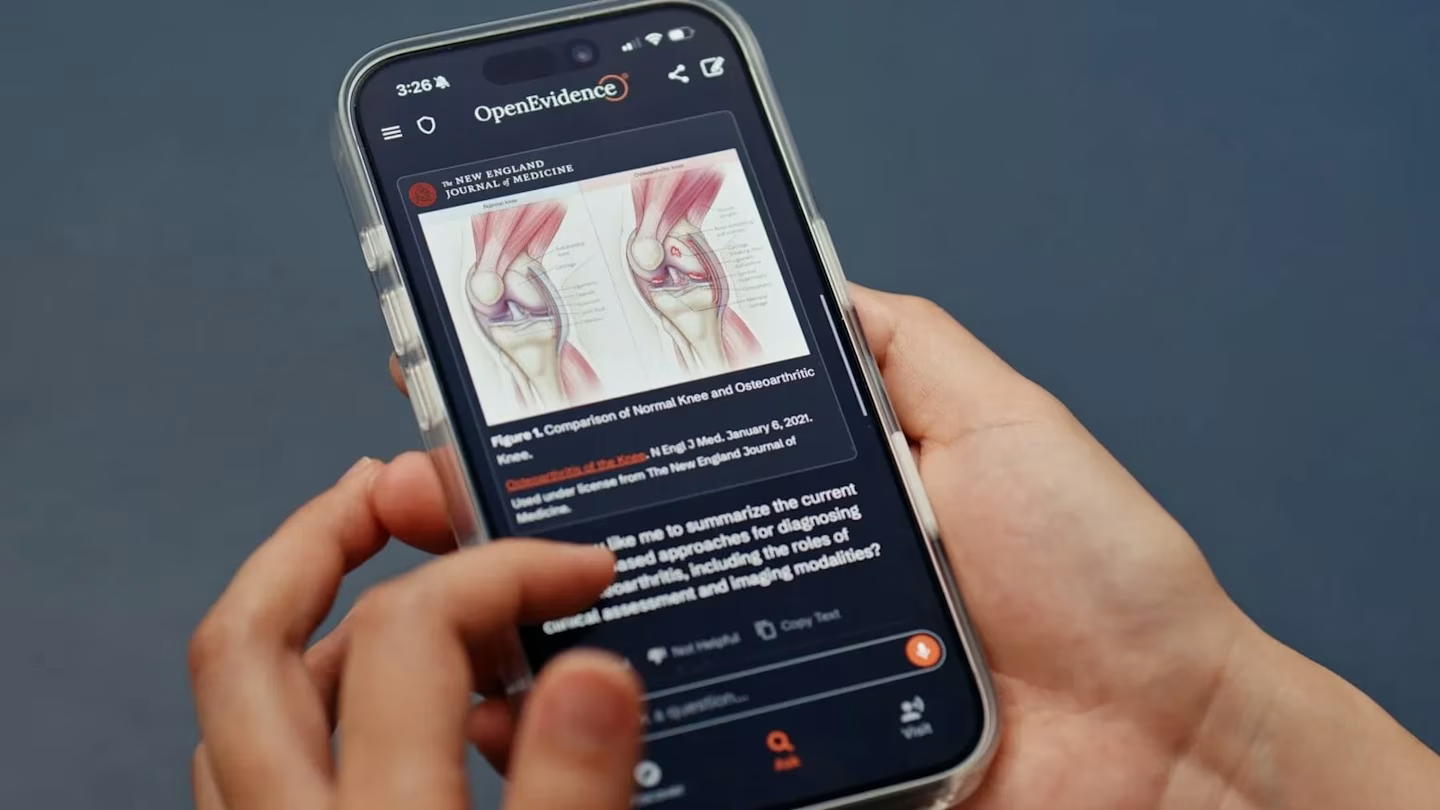
Doctors use the chatbot to scour medical journals and clinical guidelines to help diagnose and treat patients. Credit: OpenEvidence
Doctors use the chatbot to scour medical journals and clinical guidelines to help diagnose and treat patients. Credit: OpenEvidence
Text settings
Story text
Size Width * Links
- Subscribers only
Learn more
Minimize to nav
Nearly two-thirds of US doctors are turning to an AI-powered search engine to make patient decisions, propelling a little-known tech startup to a $15 billion valuation while prompting a debate over the future of patient care.
Miami-based OpenEvidence, founded by serial entrepreneur Daniel Nadler in 2022, said that many of America’s 1 million physicians processed more than 42 million prompts last month. Doctors are using the company’s chatbot to scour medical journals and clinical guidelines to help diagnose and treat patients.
The ads-powered platform has grown largely by word of mouth, penetrating a sector where few tools have seen similar traction. “We’re the first viral consumer internet app in healthcare,” Nadler told the FT in an interview.
OpenEvidence has won praise from medical professionals who have found it helped ease workloads, according to interviews with eight senior physicians.
But it faces a nascent threat from large AI companies such as OpenAI and Anthropic, who are making a push into the space. Its growing influence has also prompted scrutiny from researchers concerned over the accuracy of its results, as doctors grow more dependent on an AI tool shaping the course of treatments.
The company’s rapid ascent has attracted nearly $1 billion in investment in the past 18 months, from backers including Andreessen Horowitz, Blackstone, Thrive Capital, and Sequoia. The group raised $250 million in its latest funding round in September at a $15 billion valuation.
OpenEvidence booked $100 million in “ad buys”—a metric that covers current and future advertising commitments—for this year at the end of 2025, according to a person close to the company. The startup is on track to generate between $400 million and $500 million through ads by the end of 2026, the person added.
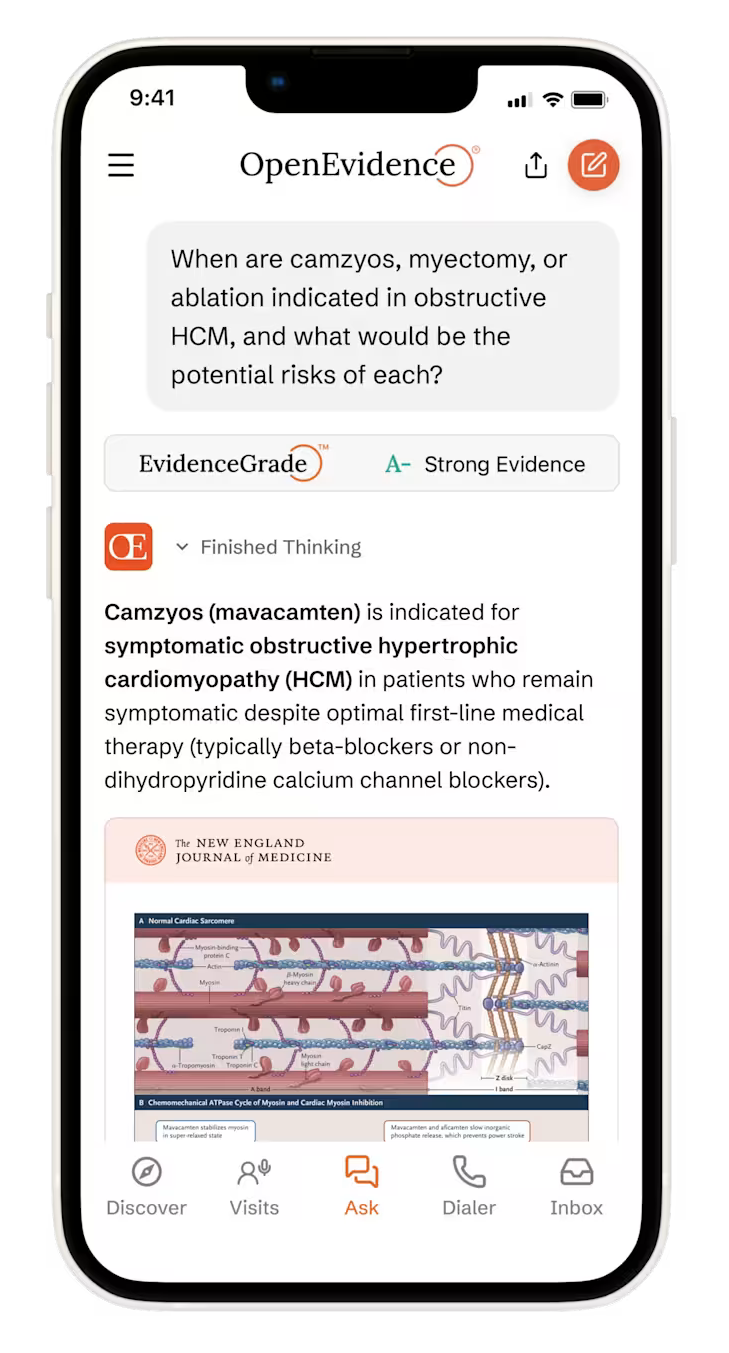
Credit: OpenEvidence
Credit: OpenEvidence
Ars Video
How Lighting Design In The Callisto Protocol Elevates The Horror
Nadler’s company has penetrated an established market for medical software that was sluggish to incorporate generative AI models. Dutch IT group Wolters Kluwer released an AI version of its leading subscription-based UpToDate medical software tool in October 2025, nearly two years after OpenEvidence entered the market.
Central to OpenEvidence’s pitch is a focused source list consisting of peer-reviewed journals such as the New England Journal of Medicine and the Journal of the American Medical Association.
“OpenEvidence allows me to provide a lot of context about my patient, find information, and make decisions faster,” said Nina Singh, a medical resident at the University of California San Francisco. “It’s a really useful tool.”
Widespread appeal has helped OpenEvidence forge relationships with several hospitals and specialist clinics such as Mount Sinai Health System and Memorial Sloan Kettering Cancer Center in New York, embedding its tool within the organizations’ electronic health records.
Paul Testa, chief health informatics officer at NYU Langone, said that the hospital system sought a formal tie-up with OpenEvidence after it found clinicians were already using the tool as an “independent resource.”
“We chose to deeply integrate a clinically informed version of OpenEvidence into the care process to ensure two things: first, our clinicians can get the most from these AI tools, and second, they use them securely,” he said.
OpenEvidence has leveraged its popularity with doctors to slowly expand into other domains, including ambient documentation—note-taking during doctors’ patient interactions.
Critics have questioned whether the company’s ad-based model warrants its high valuation, while its decision to withdraw from the EU and UK earlier this year over the bloc’s AI Act has stymied its expansion into two key markets.
Mike Vernal, a partner at venture firm Conviction and an OpenEvidence investor, said that the company’s popularity among physicians represented its strongest defense against startup rivals and incumbents.
Nadler said it will also launch clinical trials in the coming weeks, partnering with researchers to target cancer and rare diseases. It plans to apply AI models to drug discovery and draw on pre-existing literature to generate novel scientific hypotheses.
“The end game is literature-based drug discovery,” Nadler said, referencing the field of data mining scientific literature for insights. “The economic value of that as a company is going to dwarf by orders of magnitude whatever we could have charged hospitals or advertisers.”
Alexander Tarashansky, the creator of Claude Science, an Anthropic platform that supports research scientists, has also joined the company to support its clinical work.
The company needs to see off competition from frontier AI companies such as OpenAI, which has also made a play for the space with ChatGPT for healthcare. Anthropic has also released healthcare tools, though it recently partnered with OpenEvidence to bring the tools to 100 low- and middle-income countries.
“The fact that doctors are adopting and using a piece of software of their own volition means there is a degree of differentiation that OpenEvidence can really lean on,” said Nworah Ayogu, a partner at investor Thrive Capital.
But analysis of OpenEvidence’s effectiveness has led to mixed results.
One study by the Mayo Clinic, an investor in the startup, found that it “provided accurate, evidence-based recommendations” in all five patient case studies that were sampled, although its impact on treatment decisions was more limited.
Other research, including a June paper published in Nature, found that it underperformed general-purpose AI models such as Google’s Gemini and OpenAI’s GPT on clinical benchmarks.
Eric Oermann, a neurosurgeon at NYU Langone, said there was a lack of research into the performance of individual AI tools and scant guidance on how to implement the tools in a clinical setting.
There are also widely held concerns that more junior doctors could fall foul by relying too heavily on OpenEvidence and other systems without first mastering basic knowledge of particular conditions and their prescribed treatment options.
“It’s a fun, friendly competitive pressure to play with benchmarks… [But] there’s no question of what AI tool physicians trust and use,” Nadler said.
Additional reporting by George Hammond in San Francisco.
© 2026 The Financial Times Ltd. All rights reserved. Not to be redistributed, copied, or modified in any way.
Comments
 Loading comments...
Most Read
 1.The Internet goes on high alert after discovery of 8 compromised TLS certs
- 2.PHP warns it plans to release 2 emergency patches imminently
- 3.Report: Musk ordered Starlink slowdown in Ukraine, then blamed it on Trump
- 4.RIP BioWare: EA shuts down storied RPG studio after over three decades
- 5.Xbox wants you to pay 24 to 40 cents per hour to stream games you already bought
Customize
Ars Technica has been separating the signal from the noise for over 25 years. With our unique combination of technical savvy and wide-ranging interest in the technological arts and sciences, Ars is the trusted source in a sea of information. After all, you don’t need to know everything, only what’s important.
More from Ars
Contact
Manage Preferences
© 2026 Condé Nast. All rights reserved. Use of and/or registration on any portion of this site constitutes acceptance of our User Agreement and Privacy Policy and Cookie Statement and Ars Technica Addendum and Your California Privacy Rights. Ars Technica may earn compensation on sales from links on this site. Read our affiliate link policy. The material on this site may not be reproduced, distributed, transmitted, cached or otherwise used, except with the prior written permission of Condé Nast. Ad Choices
Sign in dialog...
Sign in


注意转载授权 · 阅读原文
来源:Ars Technica · AI · arstechnica.com
引用原文
Rafe Rosner-Uddin, Financial Times. The $15 billion ad-powered AI startup your doctor may already be using[EB/OL]. (2026-10-21)[访问日期]. https://arstechnica.com/ai/2026/10/the-15-billion-ad-powered-ai-startup-your-doctor-may-already-be-using/.